

Why a Proxy?
Originally nono used OS-level sandboxing (Landlock on Linux, Seatbelt on macOS) to provide a binary “switch” for outbound network access. The child process was either allowed to connect to any host on any port, or blocked from making any outbound connections at all.- Cloud metadata endpoints (169.254.169.254) - credential theft
- Internal networks (10.0.0.0/8, 172.16.0.0/12, 192.168.0.0/16) - lateral movement
- Arbitrary hosts - data exfiltration
Quick Start
Allow Specific Hosts
Using a Network Profile
How It Works
When proxy mode is active, nono:- Starts an HTTP proxy on a random localhost port
- Sandboxes the child to only connect to
localhost:<port>(all other outbound blocked) - Sets
HTTP_PROXYandHTTPS_PROXYin the child’s environment - Filters all connections through the proxy
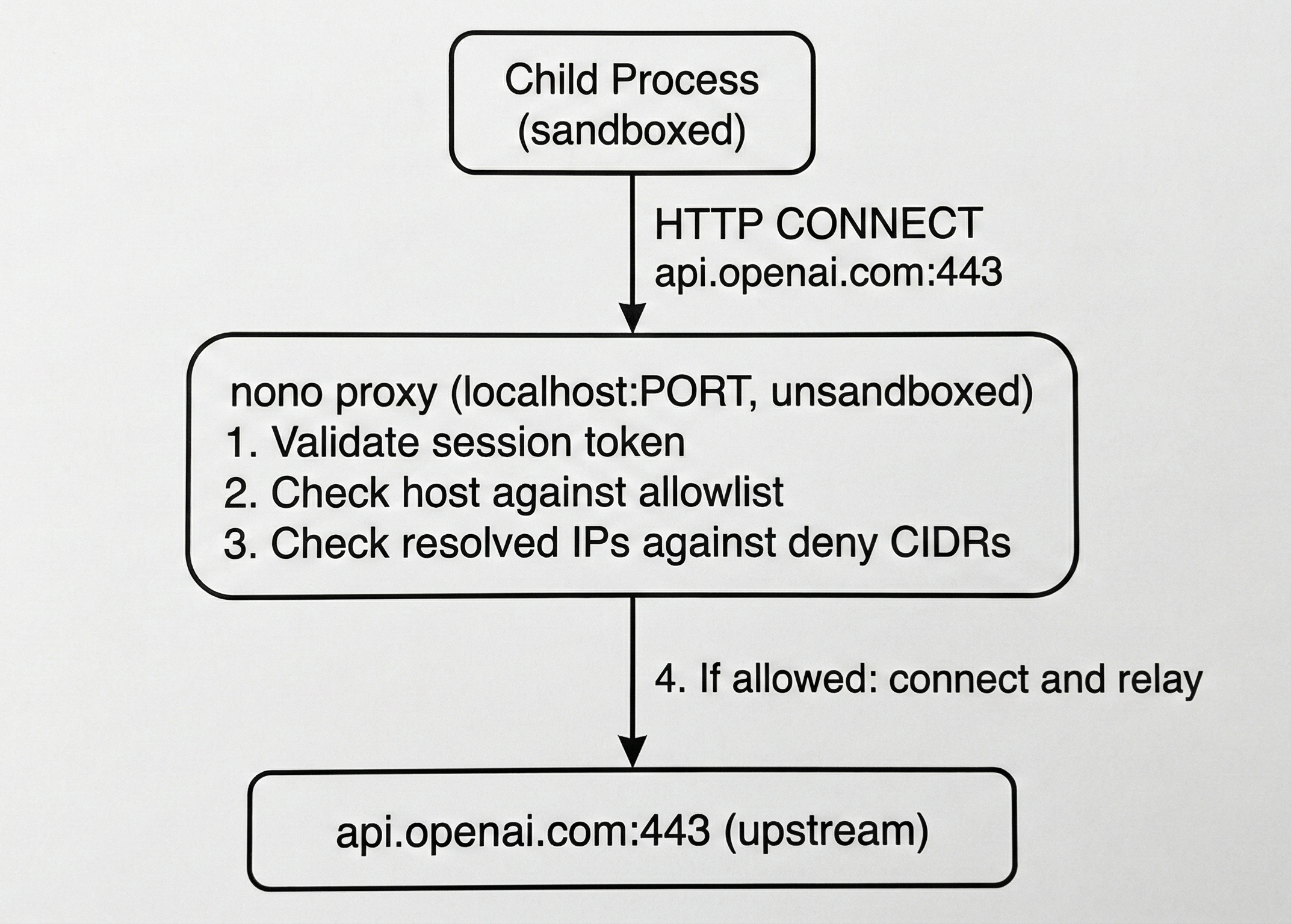
ProxyOnly mode (only localhost:<port> is reachable).
Session Token
Every proxy session generates a random 256-bit token. The child must include this token in every request (Proxy-Authorization header). This prevents other localhost processes from using the proxy.
DNS Rebinding Protection
The proxy resolves DNS itself and checks all resolved IP addresses against the deny list before connecting. This prevents attacks where a malicious DNS server maps an allowed hostname to an internal IP address.Proxy Modes
Mode 1: CONNECT Tunnel (Host Filtering)
Standard HTTP CONNECT proxying. The proxy validates the target host and establishes a raw TCP tunnel. TLS is end-to-end between the client and upstream — the proxy never sees plaintext. This is whatHTTP_PROXY/HTTPS_PROXY uses. Most HTTP libraries, curl, and language runtimes support it natively.
Mode 2: External Proxy Passthrough (Enterprise)
For corporate environments with a mandatory outbound proxy:Network Profiles
Network profiles are composable groups of allowed hosts, similar to filesystem policy groups. They’re defined innetwork-policy.json (embedded in the binary).
Built-in Profiles
| Profile | Groups | Use Case |
|---|---|---|
minimal | LLM APIs only | Minimal API access |
developer | LLM APIs, package registries, GitHub, Sigstore, docs | General development |
claude-code | LLM APIs, package registries, GitHub, Sigstore, docs | Claude Code agent |
opencode | Same as developer + bundled google-ai credential | OpenCode agent |
enterprise | All groups + cloud provider suffixes | Corporate environments |
Groups
| Group | Hosts |
|---|---|
llm_apis | api.openai.com, api.anthropic.com, generativelanguage.googleapis.com, … |
package_registries | registry.npmjs.org, pypi.org, crates.io, … |
github | github.com, api.github.com, raw.githubusercontent.com, … |
sigstore | fulcio.sigstore.dev, rekor.sigstore.dev, tuf-repo-cdn.sigstore.dev |
documentation | docs.python.org, developer.mozilla.org, doc.rust-lang.org, … |
google_cloud | *.googleapis.com |
azure | *.openai.azure.com, *.cognitiveservices.azure.com |
aws_bedrock | *.bedrock.amazonaws.com, *.bedrock-runtime.amazonaws.com |
Custom Profiles
User profiles can specify a network profile in thenetwork section:
Default Deny List
The following destinations are always blocked, regardless of configuration. These cannot be overridden.Cloud Metadata
| Host/CIDR | Service |
|---|---|
| 169.254.169.254 | AWS/GCP/Azure instance metadata |
| metadata.google.internal | GCP metadata alias |
Private Networks
| CIDR | Range |
|---|---|
| 10.0.0.0/8 | RFC1918 Class A |
| 172.16.0.0/12 | RFC1918 Class B |
| 192.168.0.0/16 | RFC1918 Class C |
| 169.254.0.0/16 | Link-local |
| 127.0.0.0/8 | Loopback (except proxy port) |
| ::1/128 | IPv6 loopback |
| fc00::/7 | IPv6 unique local |
| fe80::/10 | IPv6 link-local |
Platform Behavior
Linux
Network filtering uses Landlock V4+ per-port TCP rules. The sandbox restrictsconnect() to only the proxy port. All other outbound TCP is blocked at the kernel level.
Requirements: Landlock ABI v4+ (Linux 6.7+)
macOS
Network filtering uses Seatbelt rules. The sandbox allows only(remote tcp "localhost:PORT") and denies all other network operations.
Audit Logging
All proxy decisions are logged viatracing:
Limitations
- HTTP/1.1 only - The CONNECT tunnel passes raw bytes (HTTP/2 works end-to-end), but the reverse proxy mode speaks HTTP/1.1 to upstream
- No per-port filtering on macOS - Seatbelt cannot filter outbound by destination port (only ProxyOnly mode is supported, not arbitrary per-port rules)
- Proxy mode requires supervised execution - The proxy runs in the unsandboxed parent process, so
--execmode is incompatible
Next Steps
- Credential Injection - Keep API keys out of the sandbox
- Supervisor Mode - How supervised execution works
- CLI Reference - Complete flag documentation including network flags
- Security Model - Platform sandbox internals